I built Journey Mapper to prepare a journey map from a codebase while keeping assumptions visible. The skill labels inferred content and leaves evidence fields empty for research. Code can help describe a product's flow. It cannot establish how someone feels while using it, however finished the map looks.
On 4 June, I turned an existing journey-map template into a reusable agent skill. The idea was to inspect a codebase and use it to prepare an HTML journey map.
The output combined a customer journey with a service blueprint. The visible experience could sit beside the supporting work behind it, with shared columns for each moment.
Nielsen Norman Group's introduction to journey mapping explains the method. For this tool, I wanted enough structure to examine a flow in a design discussion without drawing the whole grid again.
The difficult part was deciding which cells the agent could fill.
A codebase can contain routes and validation rules. It can show that a flow asks for information or blocks an action until a condition is met. Those details give me material to inspect.
A person's thoughts need a different source. The presence of an error message doesn't tell me whether someone finds it confusing. A long flow doesn't establish where they become frustrated.
I can make a reasonable guess about those things. The map needs to show that it is a guess.
So I required the prefix [Assumption] on AI-inferred content, including thoughts and feelings. The evidence field stayed blank for a human to fill from actual research.
That empty field was deliberate. A generated explanation could make the grid look more complete, but it would make it harder to see which claims still needed checking.
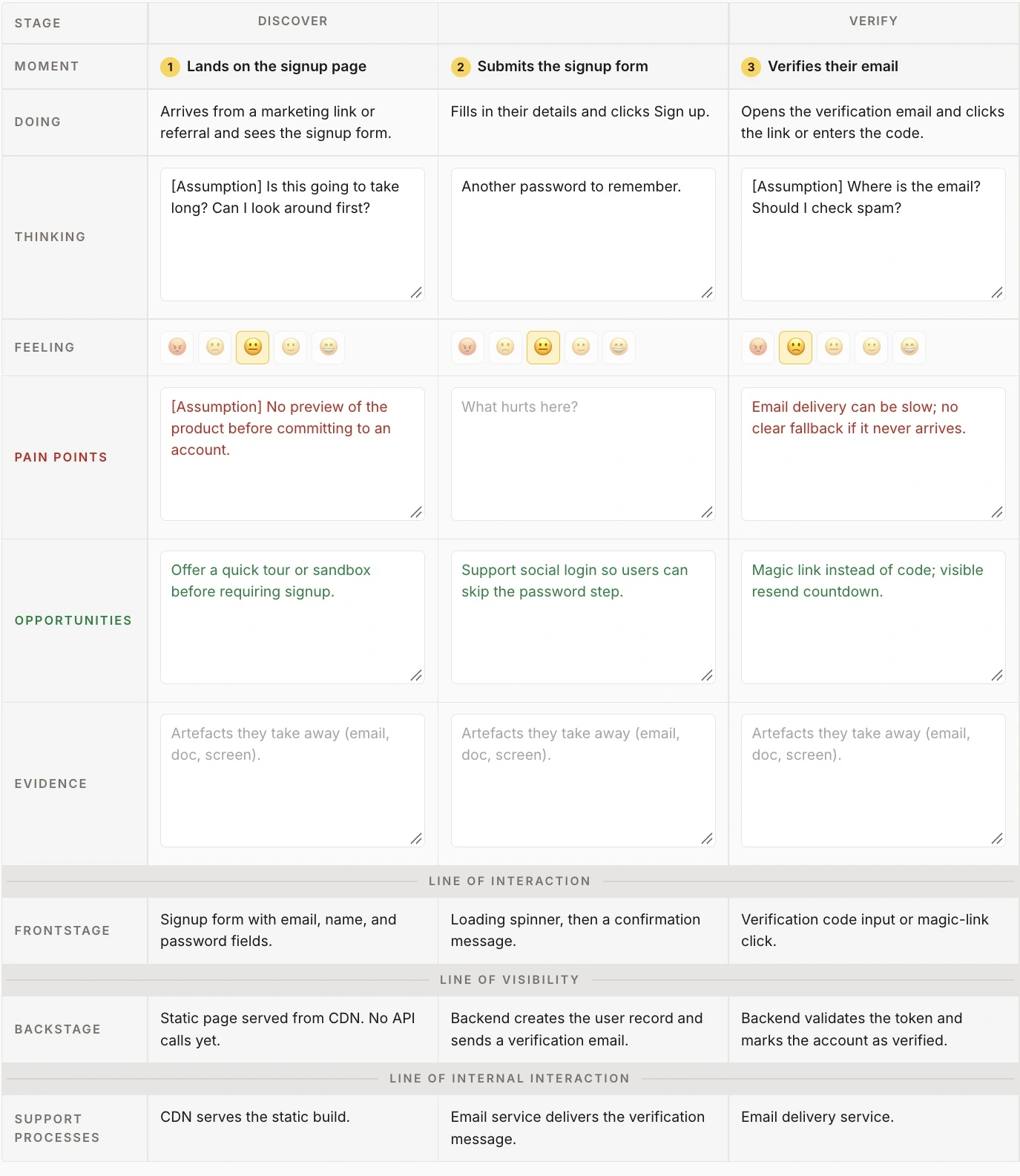
The actual HTML template, captured on 5 November. Its prefilled text and feeling scores are sample data, not research findings. The evidence fields are empty.
The emotional arc needed the same care. The format allowed a feeling score between one and five. The skill's instruction was to omit that score when the feeling was unknown.
A neutral-looking midpoint would still tell the reader something about a person's experience without a source behind it.
The screenshot also shows a limit worth keeping visible: the template includes sample feeling scores and some unlabelled example text. Those examples need clearing or marking before using it as a research record. The instructions describe the intended discipline; they don't enforce every cell.
I also wanted the tool to survive ordinary design work after generation. Someone might annotate a moment, change the presentation, or return after the product changed.
Each moment therefore needed a stable identifier. The annotations used those identifiers to stay attached to the right part of the journey. Updating the map shouldn't separate a comment from the moment it describes.
The skill read an existing HTML template and replaced its JSON data block. It didn't regenerate the presentation on every run. That meant styling changes could survive an update to the journey data.
I could adjust the map's design without asking the agent to reconstruct those decisions next time.
The build used separate instructions and reference material alongside the template. The reference defined the data format and included a worked example, so the agent had a specific structure to follow.
I also documented installation routes for several coding tools. The Journey Mapper repository holds the skill and installation guide.
At the end of the June build session, testing it against a live codebase from start to finish remained on the open list. I had built the skill and its supporting files. I still needed to verify the resulting flows against a real product.
That distinction connects to something I wrote about checking work after an agent says it is done. A complete-looking output still needs a check against what actually happened.
The useful result here was a structured draft where I could see what required investigation. Research would still need to supply the evidence about people.
For me, that is a practical role for AI in design work: prepare material for judgement while keeping unresolved parts visible.
The evidence field stays blank until I have evidence.